More than 500 Rohingya Feared Dead After Arakan Army Forced Boat to Depart Despite Severe Weather
More than 500 Rohingya Feared Dead After Arakan Army Forced Boat to Depart- Despite Severe Weather
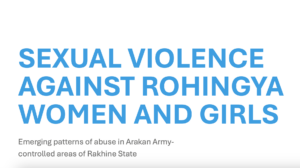
Sexual violence against Rohingya women and girls, a hallmark of the genocide committed by the Burmese military, is becoming increasingly embedded within systems of detention, coercion and control under Arakan Army (AA) authority in northern Rakhine State, BROUK warned today.
In its new briefing, Sexual Violence Against Rohingya Women and Girls: Emerging patterns of abuse in Arakan Army-controlled areas of Rakhine State, BROUK documents escalating sexual violence linked to detention, forced recruitment and repression targeting Rohingya communities under AA control.
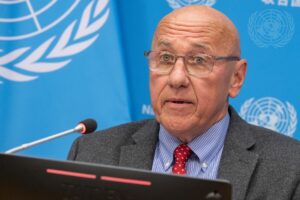
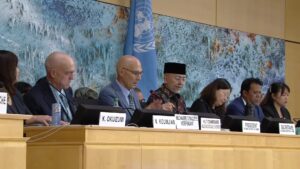
The Burmese Rohingya Organisation UK today welcomed a new report by the UN Special Rapporteur on human rights in Burma, Tom Andrews.
In his final report, the Special Rapporteur warns that the international community’s failure to act on justice and accountability has enabled the Burmese military to continue committing genocide and other atrocity crimes with impunity. He also sets out urgent steps governments must now take to deliver justice and accountability.
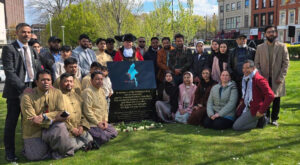
Newcastle upon Tyne, UK – History was made today as Newcastle upon Tyne became the first city in the UK and the world to unveil a permanent memorial dedicated to the victims of the Rohingya genocide.
The landmark memorial, located in Newcastle City Council’s Peace Garden, was officially unveiled following a civic ceremony at the Council Chamber and a procession led by the Lord Mayor. The initiative, led by Independent Newcastle Councillor and human rights advocate Cllr Habib Rahman, represents a powerful commitment to remembrance, justice, and global awareness.
The Burmese military and Min Aung Hlaing face multiple international legal actions for genocide and crimes against humanity, including the Rohingya genocide case at the International Court of Justice (ICJ), with a ruling expected by the end of the year. The International Criminal Court (ICC) Prosecutor has sought arrest warrants against senior military officials, and courts in Argentina have issued arrest warrants under universal jurisdiction, including against Min Aung Hlaing himself.
“Rohingya have suffered through a decades-long genocide, affecting every aspect of their lives. The generations of Rohingya victims – whether still in Burma or living as refugees elsewhere – have a right to reparations, and we hope this case in Argentina will be the first real step towards that,” said Tun Khin, President of BROUK.
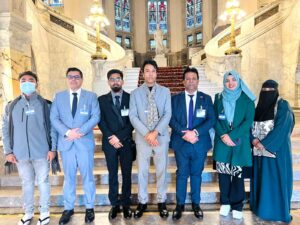
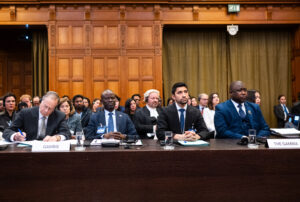
BROUK President, Tun Khin, joined the Rohingya delegation in The Hague during the public hearings at the International Court of Justice. Rohingya voices at the Court were crucial in ensuring that lived experiences and demands for justice and accountability were present, while also reminding the world that for the Rohingya, the genocide has not yet ended.
This week, public hearings began at the International Court of Justice (ICJ) in The Gambia v. Myanmar, concerning Burma’s responsibility for genocide against the Rohingya. At the ICJ, cases are brought against States, not individuals, meaning Burma (Myanmar) is answerable as a State for crimes committed against the Rohingya by the Burmese military and other state authorities.
“After six long years, Burma will finally have to answer before the Court for the crimes of 2017,” said Tun Khin, President of the Burmese Rohingya Organisation UK (BROUK). “But the genocide against the Rohingya has far from ended. Rohingya continue to face atrocities, war crimes and crimes against humanity in Rakhine/Arakan, while more than one million people remain forcibly displaced and denied their right to return home.”
The report comes just days after a new UN hunger hotspots assessment warned that Buthidaung Township in northern Rakhine State is at imminent risk of ‘IPC Phase 5 Catastrophe/Famine’ – the same classification currently applied in parts of Gaza. A military-imposed trade and aid blockade- combined with severe restrictions by the Arakan Army- is preventing life-saving humanitarian assistance from reaching Rohingya communities.