
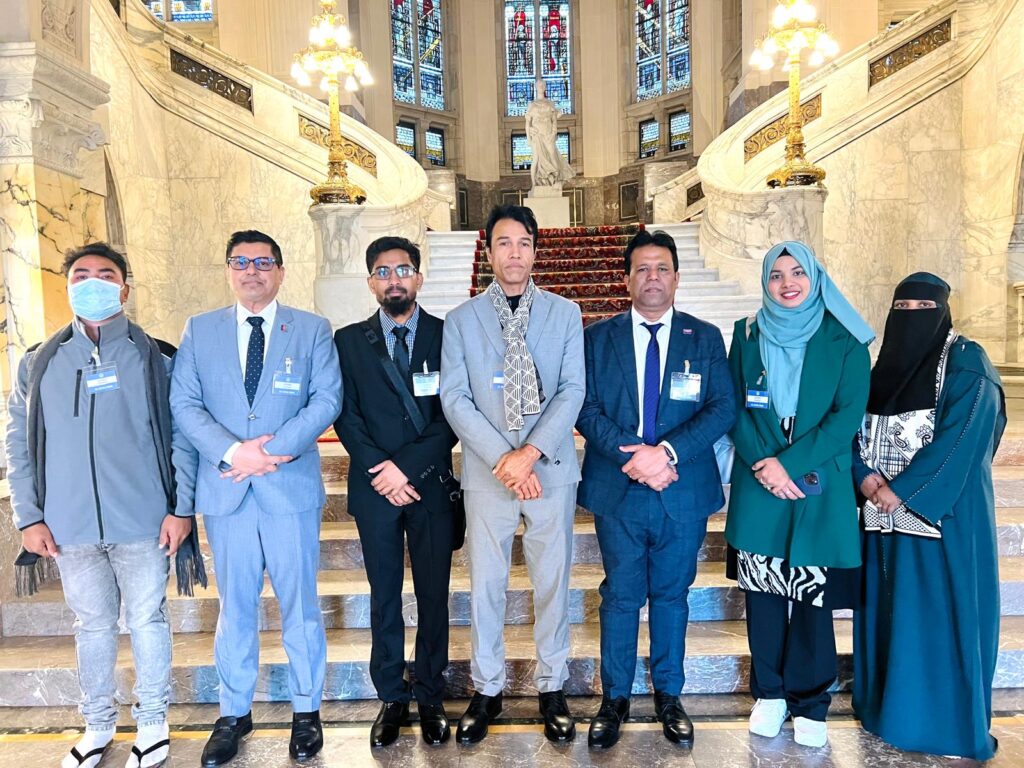
BROUK President, Tun Khin, joined the Rohingya delegation in The Hague during the public hearings at the International Court of Justice in The Gambia v. Myanmar. Rohingya voices at the Court were crucial in ensuring that lived experiences and demands for justice and accountability were present, while also reminding the world that for the Rohingya, the genocide has not yet ended.
Outside the Court, Tun Khin told the media:
“This is a very important case for the Rohingya people. We have been waiting for justice for many years. In 2017, the Burmese military killed thousands of Rohingya people and raped thousands of Rohingya women. Around one million Rohingya were forced to flee in 2017 because of the genocidal acts of the Burmese military.
I hear the same message again and again from survivors: ‘Brother, we want justice.’ And what does justice mean? Justice means getting back our land. It means returning to our villages and restoring the rights that have been taken away from us by the Burmese military since 1962.”
These remarks were widely reported across international media (see selected coverage below).
On Monday evening, alongside the Court hearings, Tun Khin also spoke at a panel discussion on advancing accountability for the Rohingya genocide. The discussion brought together Rohingya voices, legal experts and human rights advocates, and was co-organised by the Global Justice Center, Human Rights Watch, Refugee Women for Peace & Justice and Women’s Peace Network.
During the panel, Tun Khin emphasised that accountability is advancing step by step across multiple legal pathways, not through the ICJ alone. He highlighted the universal jurisdiction case in Argentina, driven by the testimonies of Rohingya survivors – in particular Rohingya women subjected to extreme sexual violence – as a crucial part of this broader effort.
He also stressed that accountability must lead to an end to the ongoing atrocities carried out by the Burmese military, not only against the Rohingya but against communities across Burma, warning that impunity continues to fuel violence nationwide.
For BROUK’s summary of what was presented in Court during the first week of hearings, see The Gambia v. Myanmar: Proceedings on the Rohingya Genocide at the ICJ
Why Accountability is Urgent
While the Court examined crimes committed in 2016 and 2017, the genocide against the Rohingya has not ended. Rohingya communities remaining in Rakhine State continue to face persecution including violence, forced displacement, starvation and restrictions on humanitarian access- all clearly in violation of binding provisional measures ordered by the Court in 2020.
Accountability through the ICJ and other legal pathways is essential not only to address past crimes but to end impunity, prevent further atrocities and secure safe return of Rohingya to their homeland.
Selected International Media Coverage Featuring BROUK:
- Al Jazeera – UN’s top court set to open Myanmar Rohingya genocide case (12 January 2026)
- The Guardian – ‘Big step forward’: Myanmar military faces Rohingya genocide case at UN court (12 January 2026)
- France 24 – Rohingya ‘targeted for destruction’ by Myanmar, ICJ hears (12 January 2026)
- Radio France Internationale (RFI) – Rohingya ‘targeted for destruction’ by Myanmar, ICJ hears (12 January 2026)
- NRC (Netherlands) – Genocidezaak tegen Myanmar is ook een test voor het internationaal recht (11 January 2026)