
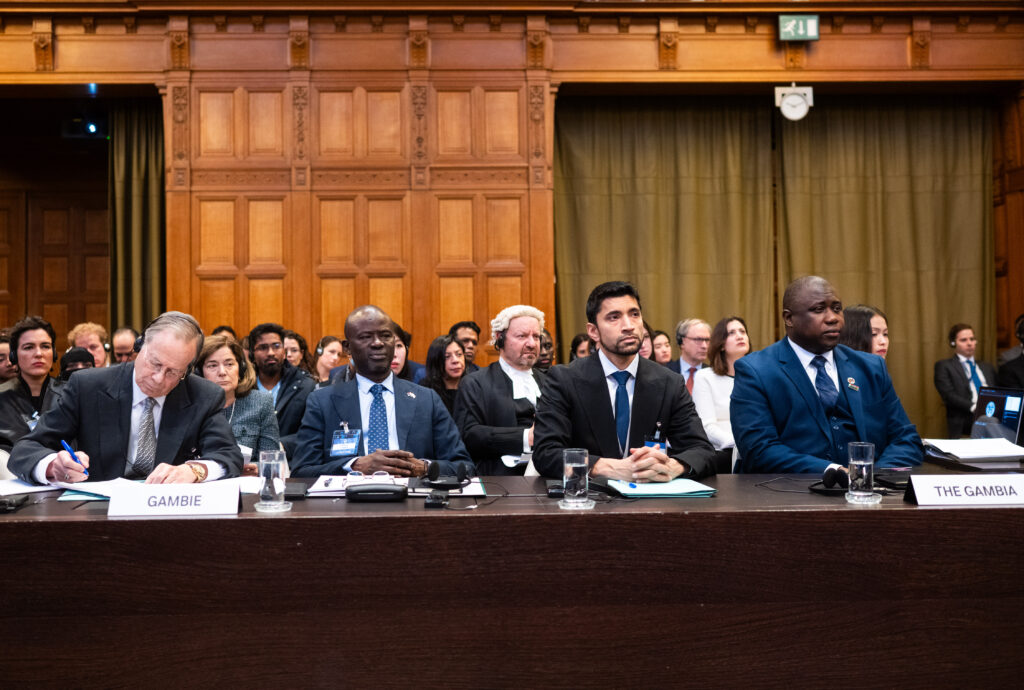
Public Hearings on the Rohingya Genocide: The Gambia’s Case
This week’s public hearings at the International Court of Justice (ICJ) mark a critical moment in the long struggle for justice and accountability for the Rohingya people. For the first time, the Court has been examining the full case brought by The Gambia, seeking to hold Burma responsible for genocide under international law.
At the ICJ, cases are brought against States rather than individuals, meaning Burma (Myanmar) is answerable as a State for crimes committed against the Rohingya by the Burmese military.
Eleven other States, including the UK, have also intervened in the case, supporting The Gambia and submitting their own legal arguments and evidence to the Court. The case has now entered the main stage of proceedings, in which judges are examining the evidence.
The start of the hearings marks a huge step forward for Rohingya justice, more than six years after the case was first initiated. During the first week of hearings (12–15 January 2026), lawyers for The Gambia set out what was done to the Rohingya and why these acts amount to genocide.
Also see BROUK’s Media statement: Burma faces the ICJ as atrocities against the Rohingya continue.
Genocidal Intent and State Responsibility
The Gambia stated that:
- What happened to the Rohingya was not accidental, isolated, or justified.
- It was planned and carried out by the State, through the actions of the Burmese military, following decades of persecution.
- The violence shows an intent to destroy the Rohingya people, at least in part.
The Court was told that genocidal intent must be understood from patterns of conduct, including the scale, repetition, and targeting of the violence.
The Gambia also pointed to the role of hate speech and incitement, including on social media platforms, as evidence of strategic planning and intent. Lawyers described how dehumanising narratives portraying Rohingya as a threat were widely circulated and amplified in the period leading up to the attacks, helping to normalise violence and prepare the ground for mass atrocities.
The “Clearance Operations”
The hearings focused on the Burmese military’s so-called “clearance operations” in 2016 and 2017.
Evidence showed that:
- The Burmese military and security forces carried out attacks across Rohingya villages in northern Rakhine State
- The same forms of violence were repeated across many locations
Villages were burned, civilians were killed, women were raped, children were attacked and entire communities were forced to flee. More than 700,000 Rohingya were driven out of Burma at this time.
The Gambia argued that this violence was systematic and coordinated, not the result of individual soldiers acting alone.
Brutality and Intent
The Gambia highlighted the extreme brutality of the Burmese military’s actions as evidence of genocidal intent.
The Court heard harrowing evidence of mass executions, people burned alive, widespread sexual violence and attacks on civilians fleeing to Bangladesh, including children and families.
This violence, The Gambia argued, cannot be explained by ‘military necessity’ and instead points to a deliberate effort to destroy the Rohingya as a group.
Long-Standing Persecution
The Gambia stressed that the genocide did not begin in 2016 or 2017.
Their evidence showed how for decades before, Rohingya were systematically denied citizenship, restricted in their movement and cut off from healthcare, education and livelihoods. Discriminatory laws and policies isolated Rohingya communities and left them highly vulnerable.
In the months directly before the military operations, humanitarian access was restricted and food supplies were cut off, further weakening communities before the violence began. This all demonstrates intent.
Crimes Under the Genocide Convention
The Gambia showed that acts carried out by the Burmese military meet several prohibited acts under the Genocide Convention, including:
- Killing members of the group
- Causing serious physical and mental harm, including sexual violence
- Creating living conditions intended to destroy the group, such as starvation and forced displacement
- Imposing measures intended to prevent births
The Court was reminded that genocide is not about numbers alone, but about whether a substantial part of a group was targeted in a way that threatens its survival.
Rejection of Burma’s Defence
The Burmese defence had previously claimed the violence was a lawful response to security threats. The Gambia countered this with evidence showing that the Burmese military destroyed hundreds of villages where no armed group was present, continued attacks after operations were said to have ended and targeted civilians indiscriminately.
Taken together, this evidence confirms state responsibility.
What Happens Next:
Burma’s representatives are scheduled to present their defence from 16 January 2026, with public hearings continuing until 29 January 2026.
After the hearings conclude, the judges will begin deliberations- with a final judgment expected to be within 6 to 12 months.
Photograph: UN Photo/ICJ-CIJ/Frank van Beek. Courtesy of the ICJ. All rights reserved.